
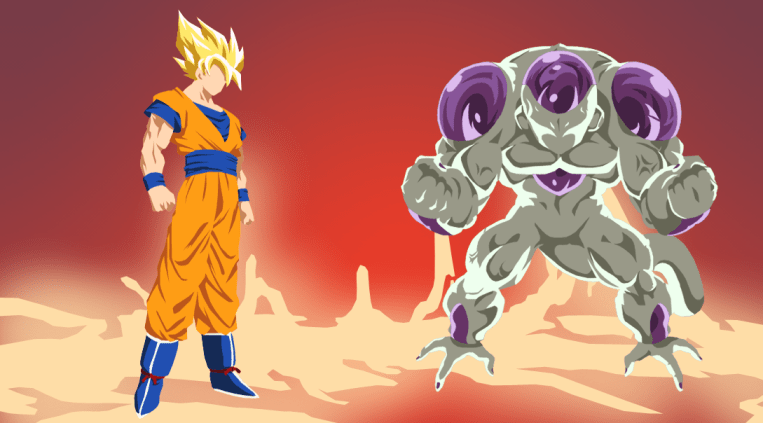
Sometimes, you can push a Transformation into a stronger or specialized version of it, rather than an entirely new Transformation.
Evolved Stages
An Evolved Stage is an additional, higher Stage that can be added onto a Form. As with Transformations, gaining an Evolved Stage for any Form is granted directly by your ARC (with few exceptions) – typically as a result of a training period spent focusing on improving a Transformation, or potentially as a result of a dramatic instance that serves as a climax for a Character’s growth.
Each Evolved Stage is tied to a specific Form, known as that Evolved Stage’s Original Form. Although you can gain the same Evolved Stage multiple times, each time it must be for a different Original Form. You can gain any number of Evolved Stages, even if they share the same Original Form.
Evolved Stages, despite being Forms that follow most of their typical rules, have a few rules unique to themselves:
- An Evolved Stage is always considered to be 1 Stage higher than its Original Form.
- An Evolved Stage is considered to be its Original Form for any and all effects, as well as part of its Transformation Line.
- An Evolved Stage of a different Original Form, even if the same Evolved Stage, is considered to be a different Transformation.
- The Racial Requirement for all Evolved Stages is the same as their Original Form.
- Unlike typical Forms, Evolved Stages apply the Attribute Modifier Bonuses of their Original Form (except any modifications that come from any effects that are not from the Transformation Traits of the Original Transformation) in addition to their own.
- Unlike typical Forms, Evolved Stages gain the Aspects of the Original Form (if they possess the Battle Uniform Aspect, the Evolved Stage gains the same Battle Uniform). If an Aspect has Levels, add the levels of the Original Form to the levels of the Evolved Stage. The only Aspects that are not gained by Evolved Stages are the Natural Aspect and the Scaling Aspect.
- The number listed for an Evolved Stage’s Stress Test Requirement will be an addition. To calculate an Evolved Stage’s Stress Test Requirement, apply the addition to the Stress Test Requirement of their Original Form.
- Higher stages of a Transformation do not use an Evolved Stage for which Traits they gain – for example, Super Saiyan 3 will possess the Traits of Super Saiyan 2, rather than Ascended Super Saiyan.
- Evolved Stages do not replace the original Stages of a Transformation for the sake of gaining even higher Stages – for example, possessing access to Ascended Super Saiyan does not mean you can gain access to Super Saiyan 3 if you are lacking access to Super Saiyan 2.
Types of Evolved Stage. There are two types of Evolved Stage:
- Generic. A Generic Evolved Stage can be applied onto any Form, as long as it meets the Prerequisites.
- Unique. A Unique Evolved Stage can only be applied onto a specific Form (and any Variants of that form), listed in brackets in the Transformation Type.
Stacking Evolved Stages. In most cases, you cannot stack an Evolved Stage atop another Evolved Stage. There is one exception to this: Evolved Stages that possess the ‘Pinnacle’ Aspect.
Evolved Stages that possess the ‘Pinnacle’ Aspect can be applied as a higher stage than another Evolved Stage if they share the same Original Transformation. In this case, the Evolved Stage with the ‘Pinnacle’ Aspect:
- Is treated as an additional stage above the other Evolved Stage.
- Is still only treated as 1 Stage higher than the original Transformation for calculating S.
- Cannot be a higher stage to another Evolved Stage with the ‘Pinnacle’ Aspect.
Evolved Stages and Legendary Traits. Evolved Stages that can be either an Alternate Form or a Legendary Form do not possess Legendary Traits, while those who will always be a Legendary Form may or may not possess a Legendary Trait.
Usually, Evolved Stages intended to bring an Alternate Form up to a level on par with Legendary Forms, or those meant to represent a tremendous increase in power, will have Legendary Traits.
Evolved Stages and Scaling. If an Original Form of an Evolved Stage, or an Evolved Stage that is stacked beneath an Evolved Stage with the Pinnacle Aspect, has the Scaling Aspect then the Evolved Stage does not gain this Aspect. Instead, it is applied atop the Transformation accounting for the Scaling Aspect. For example; if a Character has a Tier of Power of 4 and the Full Power Evolved Stage is stacked atop Power Boost, the Attribute Modifier Bonuses (FO/MA) will be 4(T) – as Scaling has increased Power Boost to 3(T).
If an Evolved Stage itself has the Scaling Aspect, then this is applied onto the Evolved Stage, using the Evolved Stage’s ToP Requirement to calculate it.
 Dragon Ball Universe